Post-election Ruminations: November 2024
As a way of personally coming to terms with the election results, I thought it might be useful for me to write a compendium of my thoughts, although a lot of this has been circulating in my brain for some time. I’m not sure my reactions match those of others, so it seemed worth recording (and sharing).
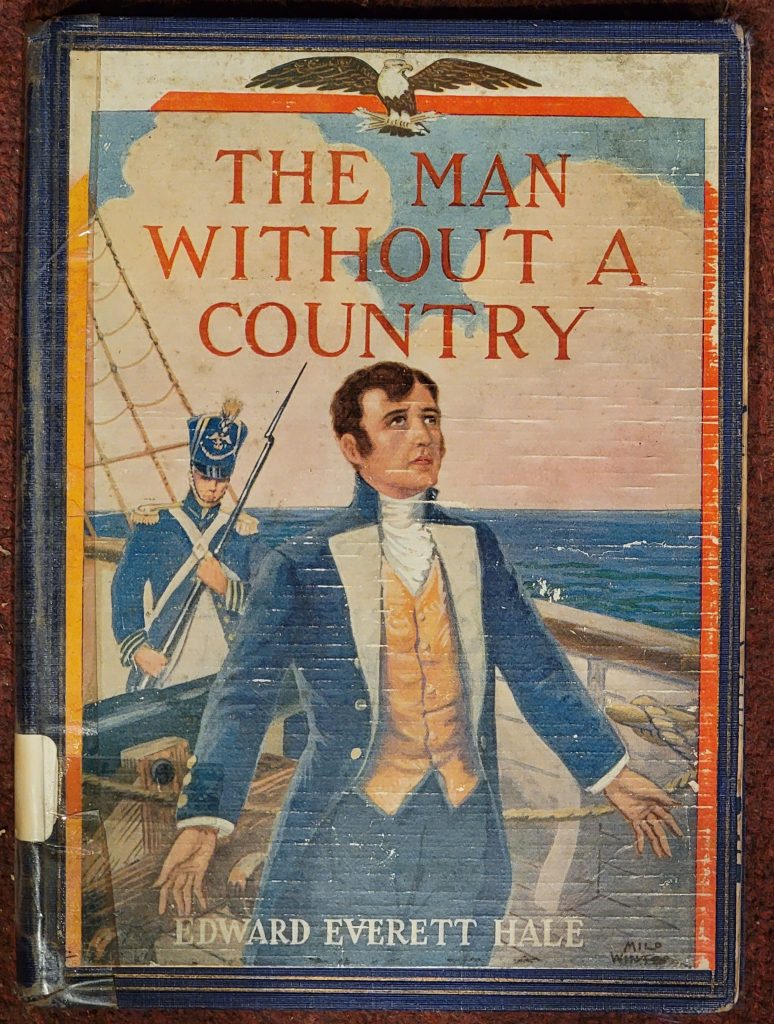
It’s likely that I read this book during my elementary school years. I surely didn’t know then that it had been written in 1863 as a Civil War lesson. What I do remember, aside from the dramatic cover, is wondering whether it referred to me. That was because the story’s banished hero, Philip Nolan, comes across lines from Walter Scott’s narrative poem, The Lay of the Last Minstrel:
Breathes there the man, with soul so dead,
Who never to himself hath said,
This is my own, my native land!
Whose heart hath ne’er within him burn’d,
As home his footsteps he hath turn’d,
From wandering on a foreign strand!
If such there breathe, go, mark him well;
For him no Minstrel raptures swell;
High though his titles, proud his name,
Boundless his wealth as wish can claim;
Despite those titles, power, and pelf,
The wretch, concentred all in self,
Living, shall forfeit fair renown,
And, doubly dying, shall go down
To the vile dust, from whence he sprung,
Unwept, unhonour’d, and unsung.
I’m quite certain that I had never heard of Scott, didn’t know that “lay” was another word for “ballad” or that a “minstrel” was anything other than a white person in black-face. And “pelf”? I could only intuit that it referred to money. I found it so compelling I can still recite it from memory, yet I vividly remember feeling discomfort about saying or thinking “This is my own, my native land!” I wasn’t certain whether I actually had a native land. I knew I had been born in what was then a reviled country. And my parents’ Zionism was trying to make me believe that I had another native land, stamped on my brain in a seemingly endless array of songs, such as
ארץ כנען מולדתי
(The land of Canaan is my homeland)
Meanwhile I was winning prizes for the best Americanism essays, edited by my super-patriotic father. Indeed, during World War II, after being rejected for military service (he had only arrived in the States in November 1937), he worked nights at the local Chevrolet factory and [for reasons I don’t understand] was even the only non-clergyman listed in the local press as being appointed a chaplain, with the honor of a special license tag added to our car.

Our family was characteristically patriotic, and I still have the 48-star flag we devoutly hung from our porch on all national holidays, as well as the cocktail napkins from my parents’ citizenship party.


Concurrently my father’s Zionist anthem was being sung at meetings and rallies across the country,
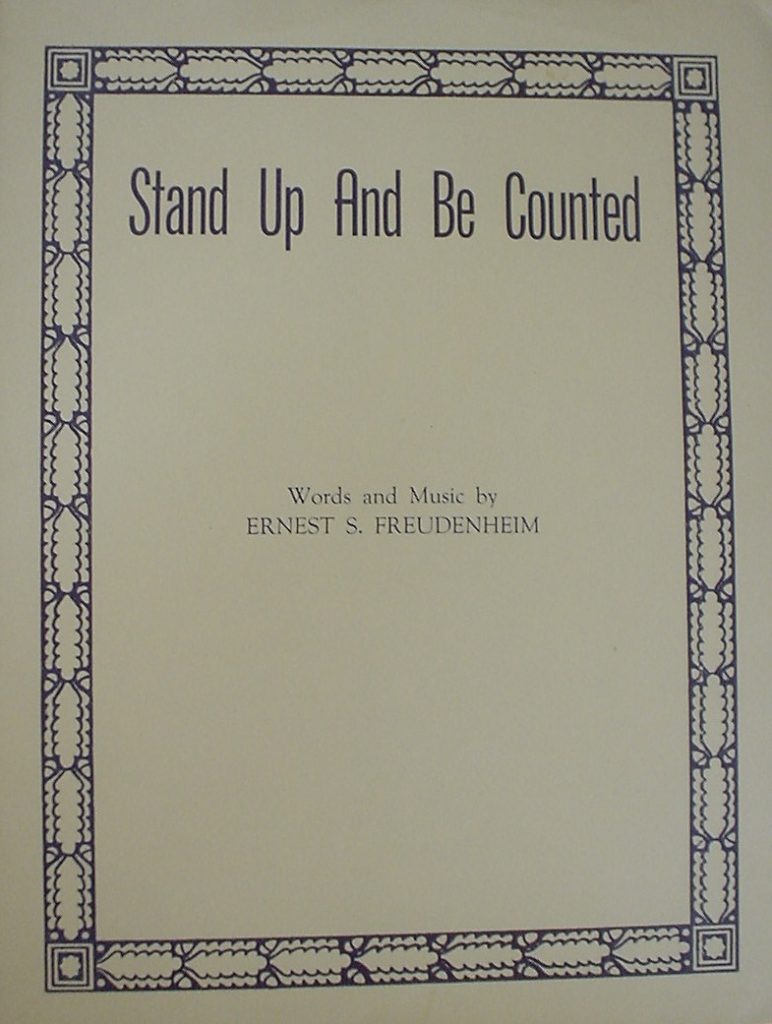
And we were standing around the piano after dinner singing patriotic American songs, Hebrew songs, and lots of what is now called the “American Songbook” to my father’s enthusiastic accompaniment.
Almost all of the post-election commentariat isn’t discussing anything of interest to me,[2] so I’m trying to figure out why I feel the way I do – namely, that I’m not sure I want to live in my country any longer.
I’ve always known I was an immigrant (albeit legal). Still, it was only after the 2016 election that I bothered to apply for my German citizenship and passport). And my personal identity as an immigrant only started to be seriously meaningful to me during the past few years of discussions about illegal immigrants. I knew enough about other previous Jewish illegal immigrant histories – e.g., the St. Louis[3] ship disaster, the problems encountered by the Exodus47[4] (no one mentions the Pilgrims) – to consider myself both connected to those histories and fortunate to have escaped them. Even as a child I knew I could never be President. But my strong immigrant identity feels more recent. In a kind of lighthearted way, I have laughed at myself as an example of the “rootless/stateless cosmopolitan Jew” (admittedly a Soviet concept). My children and grandchildren live dispersed in two countries. I am fortunate in being able to travel a great deal, so am always on the run (or is it running away?). And I am not alone, since most of what I do is accompanied by my wife/partner of 60 years. I have a slew of old and good and treasured and loyal friends. But they, too, live all over the place. The primary physical anchor I have to any single place is the burden of my attachment to the things that surround me: books, art, objects, family stuff. Nevertheless, just because the German timeline (below) spans about 13 years, and I’m not likely to be around that long, doesn’t mean I can’t be concerned. A lot of terrible things may be about to happen. Or perhaps they won’t happen. But I find that less worrying than thinking about the people (i.e, fellow Americans, i.e., voters) who have brought us here.
Looking back at more than just my family history has become increasingly unsettling. I understand that I ought to be panicked about what might happen to the judiciary, or how changed regulations will impact climate change issues, or finding myself a bystander watching Feds rounding up illegal immigrants into some kind of concentration camp-deportation system right in my Manhattan neighborhood, or the further erosion of abortion rights. But it’s the electorate that really worries me.
Facts/Timeline:
Hitler ran for president in March 1932, polling 30% in the first round and 37% in the second against Hindenburg’s 49% and 53%. Paradoxically, although the Nazis were among the main instigators of this disorder, part of Hitler’s appeal to a frightened and demoralised middle class was his promise to restore law and order. Overt antisemitism was played down in official Nazi rhetoric but was never far from the surface. Germans voted for Hitler primarily because of his promises to revive the economy (by unspecified means), to restore German greatness and overturn the Treaty of Versailles and to save Germany from communism.
The so-called “Nürnberg Laws” were first enacted in September 1935
The “Holocaust” refers to mass exterminations orchestrated by Nazi Germany between 1941 and 1945.
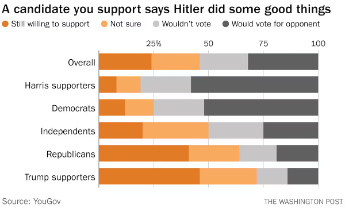
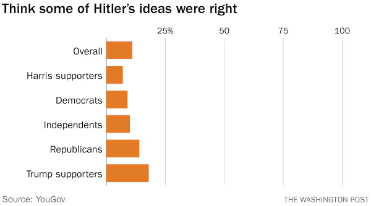
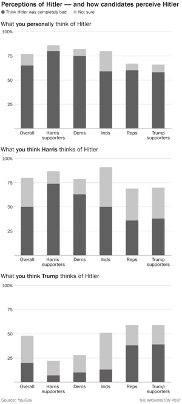
YouGov Poll, November 24, 2024:
New York Times [Headline], November 7, 2024:
Trump Is on Track to Win the Popular Vote
The projection was a further sign of the scale of Donald J. Trump’s victory. In his first successful White House run in 2016, he received fewer votes nationally than Hillary Clinton.
New York Times, November 7, 2024
Even though we were living in Berlin, during the late 1990’s, we returned to Buffalo for Passover Seder at my aging mother’s home (she died in 1999). Our family had always invited an array of types (“let all who are hungry, etc…”). During World War II there were GI’s; when the FormerSovietUnion Jews started coming, there was an array of them. Non-Jewish friends always joined us. But a memory from that 1998 or 1999 Seder stays with me because of a conversation I had with my table mate – the young Jewish wife (30-35 years old?) of a young Jewish curator at the local art museum. She was curious about how I could be living in Berlin and asked whether it was difficult for me. After assuring her that I actually loved living there I asked about her background: were her family Holocaust survivors? did she have connections with European Jewish life before or during World War II? It turned out that even her grandparents were American born, and she had grown up in a conventional Jewish environment somewhere around Chicago. Still, she found it strange that I wasn’t uncomfortable about living in Berlin.
After we moved to London in late 2000 and I had sent our change-of-address notices to all my friends I received a handwritten note from a very close family friend. I was so happy to read it, because she was someone who hadn’t been in touch with us for some time. I knew she had struggled with cancer and worried that perhaps she had died. That feeling was magnified because she had never even responded to the invitation to our older son’s wedding earlier that year. Our friend wrote: “I couldn’t bear to be in touch with you while you were living in Germany…” and then continued with normal family news. This friend, about six years older than I was (she was born in 1931), had grown up in Brooklyn in a somewhat prosperous Jewish family in the schmatte business, went from Midwood High School to Vassar, and while in no way trying to hide her Jewishness, certainly was not actively engaged in living it. We were connected mostly by our mutuality of the art world and deep friendship, and I don’t recall ever having had a conversation with her about anything Jewish (or Israel or the Holocaust, etc.).
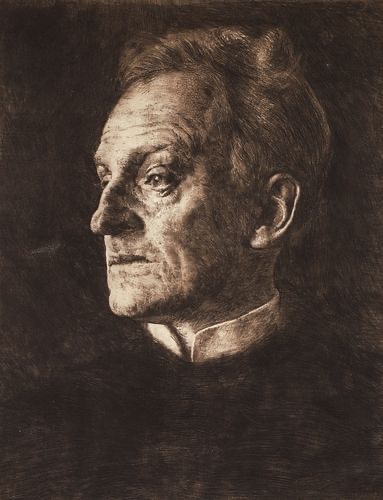
Sometime in the mid-1950’s, during one of the many times I rummaged around the Vorratszimmer[5] (storage room) on the third floor of our house, stacked behind the Wikkelkommode (baby changing table)[6] I found myself drawn to a large dark image of a severe-looking man. I asked whether I could have it for my room and my father assented. He explained that it was a portrait of the great German playwright Gerhard Hauptmann[7] – an especially large etching done by family friend and noted Jewish artist, Hermann Struck[8]. But he didn’t want it hanging in the house (or at least his part of it), because Hauptmann had been in bed with the Germans.[9] I could hang it in my room if I wanted (which I did).
That was likely the beginning of my awareness of the concept of what I now think of as the “association” problem: categorizing/stigmatizing people who may not have been Nazis but were willing in one way or another consort with them and, more importantly, wouldn’t openly denounce them: a requirement as far as my family was concerned. As a music groupie I soon understood that “the list” included super stars such as Kirsten Flagstad[10] and Wilhelm Furtwängler[11] and Richard Strauss[12]. My father, who was a gifted pianist and had even composed Berlin cabaret music in his younger days, seems never to have cared much about Richard Wagner, since I don’t recall that name as part of the accusatory discourse. The sometimes-fuzzy area of “collaborators” remains relevant for more than Nazi Germany, and we’ll soon find out whether it’s a useful term in our own country.
In the postwar WWII years there was always a very clear family rule about “things German”: you could not buy anything made in Germany! I wasn’t sufficiently insightful to question the parameters of this dictum. And I never tried to investigate the interstices of the broad mandate. After all, German sausages and schinken of all kinds were a staple of our family dining table – a table (along with lots of other furniture – and silver and glass and linens and bedding and porcelains and endless other stuff) that we had brought over from Germany in 1938. At Christmas season (we did not celebrate Christmas!) we ordered baumkuchen from a bakery in Chicago. On trips to New York, we stocked up on specialties like Berliner Weisse (beer) and other assorted German goodies at Yorkville stores like Paprikas Weiss and Schaller & Weber (which is still there).
Another important memory is a phone call from my father in around 1983 (he died in 1986) asking my advice about a very special car he saw and was tempted to buy: a leather-roofed, veneered interior, stretch Mercedes-Benz that had been custom made for some corporate executive and was for sale. Should he buy it? My reply: “I don’t care if you buy a German car, Dad. I have a VW bug.” His reply: “No, I wanted to ask whether you think it’s too ostentatious.” He did buy the car which turned out to be the great love of his final years. My parents traveled to Europe (and Israel) starting in the late 1960’s, but my father never again set foot in Germany. My mother did, to visit her older sister, who had survived the war (with her non-Jewish husband) in Upper Silesia (before it became Poland), and who lived in [then] West Berlin.
Non-judgmental about my Berlin Tante Kaethe’s remaining in Germany, there were mixed feelings (really judgments!) about what others had done. My cousin, Lonny, had emigrated to Shanghai, but returned, with her activist Communist husband to East Germany, where she died (in Berlin-Pankow). Other cousins had emigrated to Bolivia, from where they had gone to Israel in 1968, changed their German-sounding surname to an Israeli one, fought in the IDF, and then moved back to Germany (with their Bolivian-born sons). That was considered a kind of betrayal. Nevertheless, the most vituperative comments were reserved for my father’s first cousin, the celebrated novelist and writer Alfred Döblin.[13]
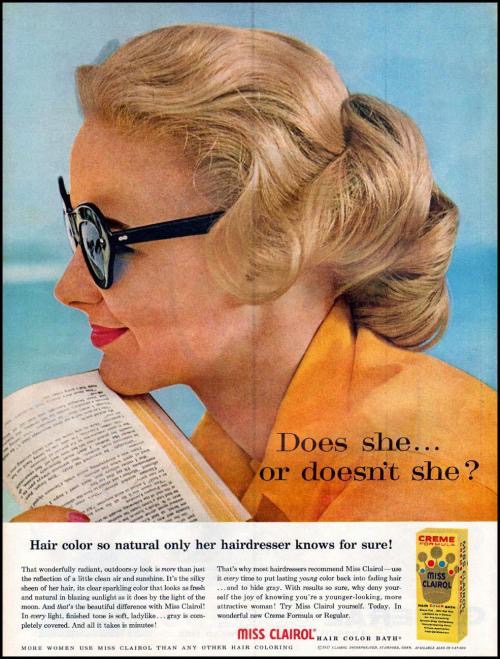
I first went to Germany (discounting the months between my birth in July 1937 and my emigration in March 1938) in the summer of 1963, as part of my two-month “grand tour” of Europe. Despite often sleeping in the car which my father had bought so I could drive around, I still imagined myself in that “grand tour” role about which I had read a great deal by then. But not in Germany – mostly Berlin – to which I considered a visit essential (and it likely was never even a highlight of the traditional Grand Tour). Germany for me was more about trying to see family sites: addresses of places lived, ancestors’ graves, locales with names I vaguely remembered having heard about. Still, in retrospect, what I most remember about that visit (and many subsequent ones, probably into the 1980’s) was always looking around at people and wondering: Did they? Didn’t they? Were they? Weren’t they? Didn’t they know what was happening? What about their parents or their relatives or their friends? Where were they when…? What did they do when….? Perhaps I was influenced by the Clairol ads of that era – the 1956 campaign about “Does she, or doesn’t she”.
Regular conversation with others who visited Germany from the 1960’s into the 80’s revealed the same [sometimes only slight] discomfort about being with and among Germans.[14]
Still, I couldn’t escape the fact that my sense of suspicion and unease was always mixed with an awkward feeling that this is where my roots really are. Over many decades and many visits those feelings of discomfort waned, then disappeared, so that by the time I was actually working in Berlin in the later 1990’s I was the oldest person on the staff of the new Jewish Museum, other than its director, Michael Blumenthal, who was 11 years my senior and had left Germany at age 13 (compared to my departure at nine months old).[15] Deciphering the people surrounding me seemed quite beside the point by then.
But another anecdote also comes to mind. Sometime in the months before I left YIVO for the Berlin Jewish Museum job, but after my new position had been publicly announced, I was lunching with a friend at The Century, when Arthur Hertzberg[16] came over to my table and whispered in my ear: “Don’t think I’m going to visit you there!” I was stunned by what actually felt like a kind of assault, but I don’t recall replying. About a year or so later, while I was living in Berlin, I received an invitation from Deutsche Bank for a reception, talk, and book-signing[17] honoring Arthur Hertzberg. I attended, of course, and whispered a warm “Welcome!” in his ear. I relate this not to mock a respected Jewish figure, but to cite that as late as the late 1990’s there were still people who were queasy about the idea of traveling to Germany.
A final background note must include the endless conversations I’ve had for decades in reply to people asking me why my family left Germany so late. In fact, my father clearly began his active pursuit of emigration in early 1936 when he traveled to Palestine to start a business and settle there. He wrote a detailed account of that journey. But the Arab riots of that year complicated the business prospects, and apparently the investors balked. He returned to Germany – Stuttgart, where my parents had settled after their 1932 marriage – disappointed at the stumbling block to his Zionist impulses and having been told (he claimed) that he would be more useful to the Zionist cause if he went to the States. Which he did in November 1937, quickly finding a job so that he could provide affidavits for the rest of us: my mother, my older brother, and our Jewish nanny; we arrived at the end of March 1938. Should my parents have started to plan their exit strategies earlier? Might they have escaped earlier? My father had a young daughter (born 1928)[18] who was living in Berlin with her mother until 1936, and surely that must have influenced emigration plans/thoughts.
Nevertheless, that question about “leaving earlier” has always been hovering.
Election 2024
Quite some time before the results were evident I had been asking myself what it feels like to live in a country in which +/-half the population appeared willing to vote for someone who not only had all sorts of outrageously bad personal and legal issues surrounding him but also had made public his disdain for the principles of government and civility – however flawed – upon which our country was based. His venomous rhetoric had a familiar ring to some. But German/Nazi analogies were generally considered out of line because so many of the circumstances were different. Invoking Santayana’s cliché[19] was supposed to be an overreaction. Still, Project 2025, a detailed and complex governing plan was available for everyone to see. This was no stealth candidate purveying bait-and-switch plans, as has happened in past elections. Certainly, more was known about Trump in 2024 than was known about Hitler prior to the 1932-33 election cycles. And even taking into account that the vast percentage of his rhetoric consist of lies, his past performance made clear both his executive powers and that of his acolytes (e.g., the changing balance of SCOTUS – i.e., Supreme Court of the United States).
The self-delusion that demands downplaying analogies between then and now is understandable because then isn’t now. The places, populations, means of communication, etc. are all vastly different. Everyone is coming up with explanations about misdirected campaign strategies, a flawed opposing candidate, too many divisions on the left side of the equation (which in some ways mirrors post-Versailles Conference Germany). But if an election is about the cost of eggs and breakfast cereal at the local market, about the common man’s dissatisfaction and disaffection, about the sense of superiority that comes from scapegoating certain categories of people, and about finding the existing government not up to the task of “doing something” about all of it, the German analogies are not so far off. Admittedly, the German economy was in especially bad shape by the early 1930’s due to punitive war reparations and the oncoming global depression. For that there is no analogy to the current American economy (low unemployment, low interest rates, wage growth, stock market records – all of which will likely be tallied up to Trump’s credit). Perceptions and rhetoric have more power than facts, even in an age when more facts are more readily available to more people than ever before. More falsehoods, too.
Which brings me to why I am writing this – a belated explanation for anyone who has read this far.
I’m 87, and even with good odds I’m not necessarily going to be around when whatever bad happens might happen. If I had been 87 in 1933, it’s unlikely that I would have been around to get sent to Auschwitz in a boxcar by 1941. Or even to have been seriously affected by the Nürnberg Laws in 1933. OK, I would have needed to find someone to shop for me during the few hours when Jews were legally permitted to shop; I would have had to find a Jewish caretaker for the personal care needs of my dotage, or maybe to help find escape mechanisms.
Checking out the significant number of Jewish megadonors who helped finance Trump’s ascent, as well as the Jewish single-issue voters (e.g., tax cuts, Israel, immigration, Ukraine) puts one in mind of the Verband nationaldeutscher Juden (Association of German National Jews) and Der deutsche Vortrupp. Gefolgschaft deutscher Juden (German Vanguard: German Jewish Followers) who supported the Nazi Party’s rise and early days, hoping that the better economy and the rejection of all those splinter left-wing groups would bring order to the chaos. I don’t know whether they were ever interviewed, but I have to assume that at least some of them might have experienced buyer’s remorse.
I’m not sure I want to live in a country where I am daily looking around at people and thinking: who did they vote for and why? will they come after me? did they? didn’t they? were they? weren’t they? didn’t they know what was happening? what about their parents or their relatives? or their friends? where were they when…? what did they do when….? That may well be common in Hungary or Poland or [my favorite country] Italy or Israel or other countries with right-wing governments; or those, like Germany, that may be teetering on the brink of drastic change. And we’ll see whether the USA ends up having one of those, too. Still, the choice in this past election wasn’t between competence and incompetence – both parties have performed the latter brilliantly and screwed up on an array of issues. From my point of view it was pretty simple: we were asked to vote for a rushed fill-in candidate with a reasonable, if limited, record and no serious personal negatives – other than the significant one of not having been tested in the traditional forges, which are supposed to steel people for the tasks ahead – or – voting for someone who proudly waved his disregard and disdain for the principles and foundations on which our country was founded and announced governing plans that could prefigure the end of the proven, if flawed, system that has sort of worked for +/- two hundred and fifty years. The 2024 presidential election was a vote between the possibility of tyranny and the likelihood of continuing to muddle through the way we have done for generations. I’m not keen on looking around at my friends and neighbors, people on the street or on the bus or subway or at museums or concerts and such and asking myself the questions that propelled me through my early visits in Germany. Been there!! Done that!!
Are other countries better? Do they have fewer people who would vote for a Trump? Perhaps not, but in any case, even in the countries with problematic parliamentary systems and rightwing governments – including Israel – the promise of tyranny hasn’t gotten 50% of the popular vote. The Bard’s Julius Caesar warned us that “Cowards die many times before their deaths; the valiant never taste of death but once.” Evidently my post-election blues signify cowardice. So yes, the option of leaving feels very real to me, even if I’m willing to admit that this reveals me as more timorous than ever thought myself to be. This also feels like a betrayal of the allegiance and confidence that my parents placed on the country which so warmly embraced them and to which they remained incredibly loyal. But in a very personal way – I don’t lay this on others – I guess it’s my defense against a perceived imminent betrayal by that same country.
Which is why I’m feeling my way through a kind of the classical Jewish journey, without a promised land in sight.
[1] Today it feels a tad awkward to recall that I was also singing שיר הפלמ”ח (Shir [song of the] ha’Palmach), which included the memorable lines: ממטולה עד הנגב — מן הים עד המדבר i.e, “from Metulla (north) to the Negev, from the sea to the desert…” Palmach was the elite strike force of the Haganah, precursor to the IDF.
[2] Blaming a weak candidate and/or campaign, Biden’s selfish decisions several years ago, Democratic Party’s disorder, bad/flawed messaging from Harris, not speaking to the ‘real’ needs of voters: issues connected with the economy, immigration, homelessness; defending ‘woke’ policies; the Israel/Gaza war issues; Ukraine; perceptions of machismo, etc. The same media that made the rise of “a Trump” possible can now fuel itself on dissecting the results.
[3] In 1939 the ocean liner MS St. Louis carried more than 900 Jewish refugees across the Atlantic and, after being denied landing in Cuba, the USA, and Canada, returned to Europe where many or most of the passengers likely parished in the Holocaust.
[4] The American steamship USS President Warfield was renamed Exodus 1947 to take part in the post-war effort to bring Holocaust survivors, who had no legal immigration certificates, from France to Palestine.
[5] I should explain that although my parents never spoke German with each other or to us (“I don’t want my children to learn the language of murderers”), German words for household things were in common use.
[6] The Wikkelcommode had served as a changing table for my father (b. 1904) and his older sister, and by then also for my brother (b. 1934) and me (b. 1937). It was later used for all of my father’s grandchildren, and some great-grandchildren as well. In my childhood it was just a storage bin and I don’t even think I knew what it’s purpose was.
[7] Gerhart Hauptmann (1862-1946), the German playwright, poet, and novelist, won the Nobel Prize for Literature in 1912.Barely tolerated by the Nazi regime, he was also denounced by émigrés for staying in Germany.
[8] Hermann Struck (Chaim Aaron ben David) (1876-1944) was born in Berlin, studied at the Berlin Academy of Fine Arts, joined the Berlin Secession in 1904. In 1900, Struck met the Dutch artist Jozef Israëls, who became his mentor. Struck’s students included Marc Chagall, Lovis Corinth, Jacob Steinhardt, Lesser Ury, and Max Liebermann. Struck and his wife Molly lived in the same Berlin building as my grandparents. He was an important mentor to my father.
[9] Did my father notice that on the lower left corner, Struck had signed his name with a “Jewish” star?

[10] Kirsten Flagstad (1895-1962) was probably the outstanding Wagnerian soprano of her time
[11] Wilhelm Furtwängler (1886-1954) was among the greatest orchestra conductors of his time.
[12] Richard Strauss (1864-1949) was an important German composer.
[13] Alfred Döblin (1878-1957) was best known for his 1929 novel Berlin Alexanderplatz, but also wrote a great many other works. He had settled in Los Angeles in 1940 and was part of its celebrity emigré cultural circle that included Thomas Mann and Arnold Schoenberg. He returned to Germany in October 1945. That, along with Döblin’s conversion to Catholocism (he was baptized in Beverly Hills in 1941), assured him a place of honor on my father’s shitlist.
[14] There are likely many people, especially older Jews, who still feel that way.
[15] He wrote a book about his experiences: The Invisible Wall: Germans and Jews: A Personal Exploration (1998).
[16] Arthur Hertzberg (1921-2006) was a Conservative rabbi and prominent Jewish-American scholar and activist.
[17] I believe it was for his book Jews: The Essence and Character of a People (1998) (co-authored with Aron Hirt-Manheimer).
[18] Margit Freudenheim (1928-1942) was his daughter with my father’s first wife. She lived in Berlin with her mother until they left for Paris in 1936. They were both deported to and murdered in Auschwitz in November 1942.
[19] “Those who cannot remember the past are condemned to repeat it.” George Santayana in “The Life of Reason, or The Phases of Human Progress” (1905).